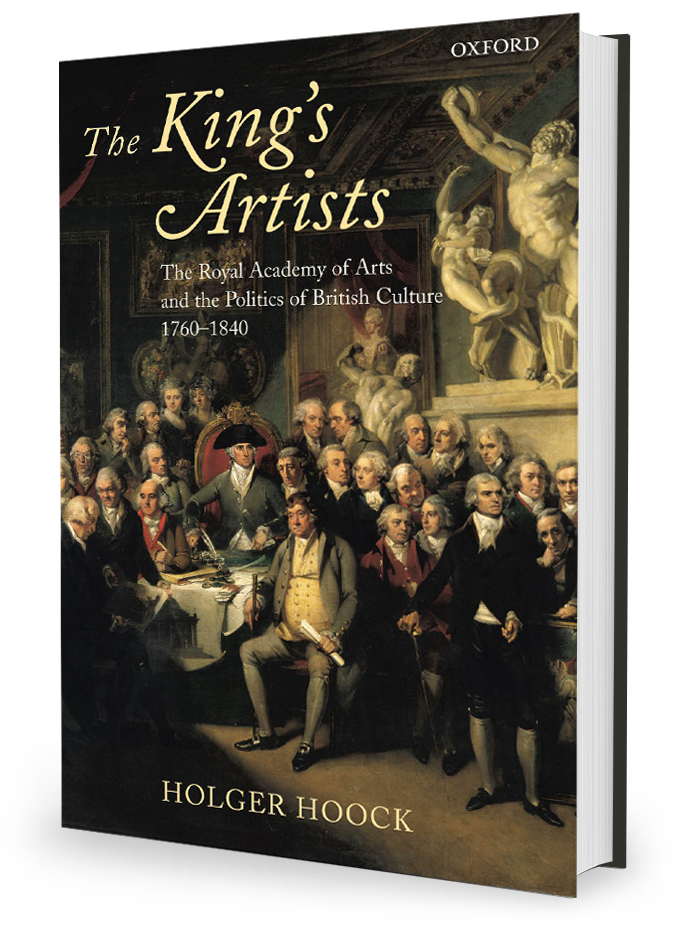
This is the story of the forging of a national cultural institution in late eighteenth- and early nineteenth-century Britain. The Royal Academy of Arts was the dominant art school and exhibition society in London and a model for art societies across the British Isles and North America. THE KING’S ARTISTS is the new standard account of its early years, re-evaluating the Academy’s significance in national cultural life and its profile in an international context. Holger Hoock reassesses royal and state patronage of the arts and explores cultural patriotism and the politicization of art during the American and French Revolutions. By demonstrating how the Academy shaped the notions of an English and British school of art and influenced the emergence of the British cultural state, he illuminates the politics of national culture and the character of British public life in an age of war, revolution, and reform. Deeply researched and presented in a clear narrative style, THE KING’S ARTISTS also portrays power struggles and artistic rivalries, the annual summer exhibition and sumptuous Academy dinners, thus bringing the beginnings of modern Britain’s oldest surviving art institution to life.
Buy the Book
Reviews
“path-breaking book”
Philip–Leverhulme–Prize Citation (2006)
“Holger Hoock’s book…really is the synoptic analysis that British art history has been waiting for, and for that reason alone its appearance is an important event.”
–Alex Kidson, Burlington Magazine
“learned, lucidly-written book … fascinating chapters and case studies really bring Hoock’s argument to life. … Underpinned by extensive research, Hoock’s important study will become indispensable for all scholars interested in the early history of the Royal Academy. [It] also stimulates new thinking about the broader relationships between art, politics and bureaucracy, both in the particular historical period it covers, and during the many years since.”
–Mark Hallett, The Royal Academy Magazine
“a densely argued, well-referenced book that brings together a mass of archival material, some familiar, much freshly mined. It adds substantially to the literature on what it convincingly presents as a central and vital component in the composition of the British imperial establishment”
–Andrew Wilton, The Art Newspaper
“Now available in paperback, Holger Hoock’s The King’s Artists has, in the few years since its publication, become the standard account of the early years of the Academy”
–John Bonehill, Oxford Art Journal (2008)
“a careful analysis of the inner machinations of the Academy and the Academy’s relations with the state. Hoock succeeds in repositioning the Royal Academy as an active site of political exchange in British culture. This book is an intelligent, and necessary, critical addition to the study of British culture.”
–Joan Coutu, Journal of British Studies
“beautifully produced, and the illustrations, which are important to the argument, are well-chosen and plentiful”
–John Cannon, English Historical Review
“the best account that we have of the institutional history of the RA, and of its impact and consequences”
–Reviews in History (online)
“Hoock’s detailed examination of the archives at Burlington House, of the papers of individual artists and of official records gives this study an impressive authority.”
–Francis Russell, Apollo
proxime accessit, Royal Historical Society, Whitfield Prize for the best first original and scholarly book in British History (2004): The book covers “a wide range of material in a very accessible way, is impressive in its interdisciplinary scope, and has very important implications for the relationships between cultural patronage, nationalism and the state in a crucial period”
To book Holger for interviews, lectures, book signings, or other events, please contact his publicist:
Sarah Grimm, Crown Publishing Group / Penguin Random House