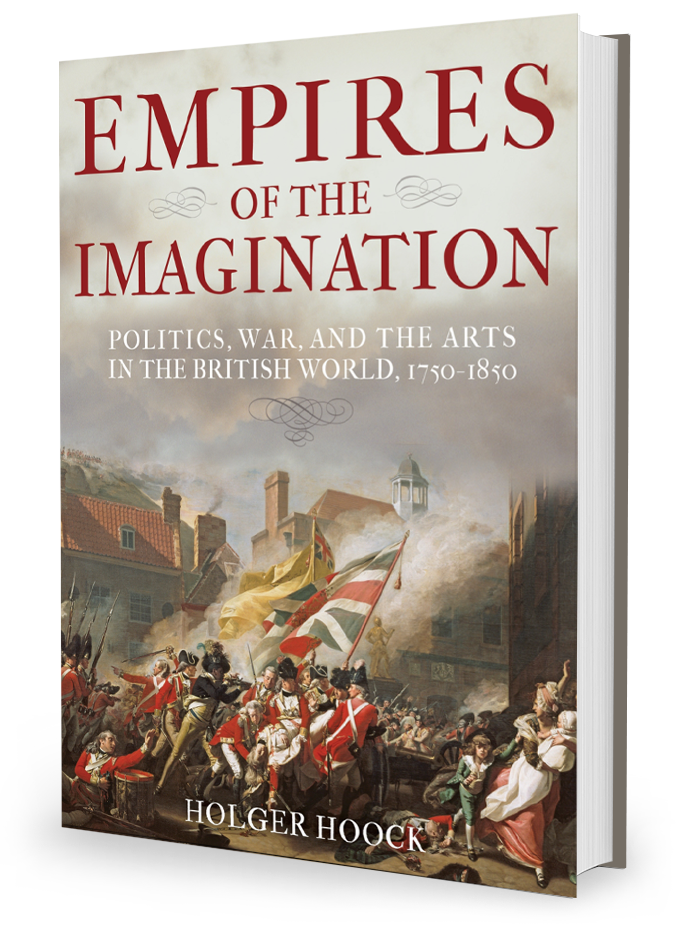
Empires of the Imagination: Politics, War, and the Arts in the British World, 1750-1850
Hardback. xxx + 514 pages, 4 maps, 20 colour, 48 black and white ill., Profile Books, London, 4 Feb. 2010. Price: £30.00
ISBN-10: 1861978596
Click to buy on Amazon [UK]. Click to buy on amazon.com. Click to buy on AbeBooks.
Please scroll down for a summary, excerpts from reviews, and links to rich media content.
____
Summary
This is a scholarly and accessible history of the multi-faceted relationship between the arts, politics, and war in Britain and the British Empire between the mid-18th and mid-19th centuries.
Over the course of the century after 1750, Britain evolved from a substantial international power yet relative artistic backwater into a global superpower and a leading cultural force in Europe. Empires of the Imagination illuminates the manifold ways in which the culture of power and the power of culture were interwoven in this period of dramatic change. Britons invested artistic and imaginative effort to come to terms with the loss of the American colonies; to sustain the generation-long fight against Revolutionary and Napoleonic France; and to assert and legitimate their growing empire in India.
Holger Hoock explores the controversial careers of America’s leading painters during her War of Independence and analyses the unique British military and naval pantheon created at St Paul’s Cathedral at the turn of the nineteenth century. Demonstrating how Britain fought international culture wars over prize antiquities from the Mediterranean and Near East, the book offers a fresh interpretation of the origins of the British Museum’s collections. Detailed studies of Britons and their local assistants who first documented the ancient monuments of India and Java contribute to debates about Orientalism and the production of imperial knowledge. From Athens to Amaravati, British archaeological interventions prompted concerns about plunder and preservation.
Drawing on a very broad range of textual sources and material culture, Empires of the Imagination seeks to revise our understanding of the cultural role of the Hanoverian and early Victorian British state. By putting British culture into an international context, it highlights both European similarities and its distinctly British features.
____________
Praise for Empires of the Imagination:
“illuminating and entertaining, … lavishly and intelligently illustrated, … an original, scholarly but accessible book” – Prof. TIM BLANNING, Literary Review, April 2010
“a hefty, exceptionally learned and exhaustively … researched book … Hoock’s feel for the creative disorderliness of the time is a pleasure”. Prof. SIMON SCHAMA, Financial Times, March 2010 – Read the full review here.
An “ambitious, authoritative survey of British visual culture in an age of imperial ascent … a sweeping … grand tour of the chief sites of British cultural and imperial activity” - Prof. MAYA JASANOFF, Guardian, March 2010 – The full review is here.
“both a synthetic extension of [John] Brewer’s work and also a key revision of it.” Hoock “should be congratulated for framing the material in such a grand manner. It’s exciting to see a book with a big argument about a big narrative so well told.” (Huntington Library Quarterly, 2011).
A “hefty, superbly detailed book … a remarkable achievement, as sumptuous in argument as it is in presentation. Herald Scotland, April 2010
“Hoock’s descriptions of great archaeological discoveries are thrilling; the account of the politics which lay behind the expeditions will challenge many views of this period. I can’t imagine that anyone who reads this book won’t immediately head off to the British Museum to look with fresh eyes on familiar objects.” Ben Wilson, History Today, May 2010. Read the full review here.
“Hoock’s analysis is of an astonishing breadth. [His] narrative architecture renders his book pleasurable to the academic and the amateur historian alike. It proves equally entertaining and encyclopaedic by virtue of good story-telling. … By his deft discernment of pattern in detail, he proves himself master of his subject in this empire of political and artistic tales.” Deborah Rosario, Oxonian Review, May 2010. The full review is here.
“beautifully produced, closely argued and deeply researched … He has scoured the sources to analyse an almost stupefying number of artistic artifacts and endeavours – from paintings to sculpture and monuments, from exhibitions to musical compositions, from architecture to the tangible and salvageable residue of past or “other” civilisations, like ancient Greece or India.” Hoock’s ”original conclusions … include a radical re-evaluation of the impressive scope and depth of Britain’s artistic achievements compared with those of its major European rivals … above all he claims that the warlike and aggressive British state was a very important agent for cultural change. Empires of the Imagination is an important, weighty book. It deserves close scrutiny and a warm reception.” Professor Denis Judd, BBC History Magazine, March 2010. For the full review click here.
A “learned, engrossing book”. “Hoock’s discussion of the artistic response to the American Revolution is a model of scholarly insight.” –”a sumptuous treat indeed.” - Dominic Sandbrook, Daily Telegraph – The full review is here.
A “book chock full of vivid case studies” , written with “real verve and pace. … He’s played a blinder”. Dan Jones, SPECTATOR - For the full review click here.
“Empires of the Imagination is an ambitious, original and wide-ranging study of how eighteenth- and nineteenth-century imperial power was made manifest in a variety of cultural media, especially the visual arts. Covering three continents and a range of detailed case studies, it combines breadth and depth, explaining how the British state and the ruling political and artistic elites worked together to create a powerful conception of the British empire.” Prof. JOHN BREWER, California Institute of Technology, author of The Pleasures of the Imagination: English Culture in the Eighteenth Century.
“Empires of the Imagination is a bold, provocative and ambitious book that seeks to develop an integrated form of history, which does justice to the entangled relations between culture and politics, as well as to a variety of cultural forms, including art, exploration, music, monuments and the appropriation of non-European artifacts. It includes close readings of performances, places and images while reminding readers of the importance of bigger historical pictures. Clearly and elegantly written, and thoughtfully illustrated, this volume brings together collecting and memorialisation, travel and national identity, heroism and diplomacy, war and aesthetic drives in fruitful ways. It presents a wide perspective on an exceptionally significant era for the British world.” Prof. LUDMILLA JORDANOVA, King’s College London, author of History in Practice.
__________
To start exploring the book, flick through the Contents, read an excerpt from the opening, or browse the detailed Index of subjects, names, and places.
BIBLIOGRAPHY
For reasons of space a bibliography could not be included in the book. A bibliography of the archives consulted, and of printed primary and secondary materials cited in the endnotes, is available here [opens a pdf file to print or download].
Here’s the Profile Books catalogue entry.
Click to buy on amazon.co.uk
Click to buy on amazon.com
_________________________________________________________________________________
Explore further by following these links to see works of art and iconic objects, listen to music, and visit national cultural institutions and British and imperial sites discussed in the book.
The book features some 20 colour plates and 48 black and white illustrations. Links below are to works of art that are discussed in the book, but could not be reproduced there.
PRELUDE: The Coronation of George III, Sept. 1761
J. L. Natter, Coronation of George III (coronation medal, 1761; Royal Collection) * Unknown, Queen Charlotte (c. 1761; Royal Collection)
Coronation Anthems: G. F. Handel, Zadok the Priest. Click here for a video of Her Majesty Queen Elizabeth II, on the occasion of Her Golden Jubilee in 2002, processing down The Mall in George III’s Golden State Coach to the accompaniment of Zadok. A much better paced version, recorded at the Golden Jubilee Buckingham Palace Concerts, is here. Another Recording of the full piece by Les Arts Florissants. Handel’s My Heart is Inditing: Recording, Les Arts Florissants.
Diamond keeper ring presented by George III to Queen Charlotte on their wedding day, 8 Sept. 1761.
Silver-gilt Cup and Cover presented by George III to the Mayor of Oxford as part of his fee for serving as Under Butler at the Coronation Banquet.
_______________
AMERICA (chapters 1, 2)
Westminster Abbey: monuments of statesmen and military heroes: William Pitt the Elder, Earl of Chatham * Admiral Rodney’s Three Captains * William Wragg (American Loyalist) * Major John André (British hero and spy) * Sir Eyre Coote
John Bacon, Monument to Chatham (Guildhall)
Saratoga National Park: Virtual tour of Saratoga Monument * Monument to Arnold’s Leg
Paintings:
Ralph Earl, Portrait of Adm. Richard Kempenfelt
Thomas Gainsborough: Col. St Leger (1782; Royal Collection). * George IV, when Prince of Wales (1782; Royal Collection).
James Gillray, Dutchman in the Dumps
Charles Willson Peale: William Pitt (1769; Maryland State House). * General Washington at Princeton (1779-81; Metropolitan Museum of Art, NYC).
Jonathan Trumbull, Paintings in the Rotunda of the U.S. Capitol, Washington, DC: Signing the Declaration of Independence * The Surrender of General Burgoyne at Saratoga * The Surrender of Cornwallis at Yorktown * Washington Resigning His Commission
Henry Walton, Plucking the Turkey (exh. 1776; Tate).
Benjamin West: The Battle of La Hogue (c.1778; National Gallery of Art, Washington, D.C.) * Oliver Cromwell Dissolving the Long Parliament * George III (Royal Collection; 1779) * Signing of the Preliminary Treaty of Peace in 1782
_____________
INTERLUDE: Royal Academy and Handel Commemoration (1784)
St Paul’s Cathedral – British Military Pantheon in the French Revolutionary & Napoleonic Period:
Bacon, Capt. G. Duff * Banks, Capt. G. B. Westcott * Chantrey: Maj.-Gen. B. F. Bowes * Maj.-Gen. Daniel Hoghton * Maj.-Gens A. Gore and J. B. Skerrett * Rossi: Capt. C. Faulknor * Capts J. R. Mosse and E. Riou * Gen. Marquis Cornwallis * Theed, Sir W. Ponsonby * Westmacott: Adm. Collingwood * Maj.-Gens Sir E. Pakenham and S. Gibbs
Paris: Sites of National Commemoration: Les Invalides * Panthéon
Nelson’s Funeral: G. F. Handel, Funeral March from Saul. Recording with Gabrieli Consort & Players.
Nelson monuments in the British Empire: Barbados * Montreal, Canada
_______________
MEDITERRANEAN & NEAR EAST (chapters 5, 6)
Johann Zoffany, The Tribuna of the Uffizi (1772-7) [online exhibition at The Queen's Gallery, 2009]
British Museum: Rosetta Stone * Parthenon * Bassae Sculptures * Nereid Monument * Niniveh * Nimrud
International competition over antiquities: Louvre, Paris * Egyptian Museum, Berlin * Glyptothek, Munich
_______________
INDIA (chapters 7, 8 )
Spiridone Roma, The East Offering Its Riches to Britannia (1778) * Robert Home, Reception of the Mysore Princes by Lord Cornwallis * Death of Colonel Moorhouse at the Storming of the Pettah Gate of Bangalore
Archaeological Survey of India (with videos and other features on several sites discussed in my book)
Calcutta: South Park Street Cemetery * Asiatic Society
British Museum: Amaravati
_________________
CAPITAL OF CULTURE: LONDON, c.1815-1850 (chapter 9)
Celebrations of Peace, Allied State Visit, and Hanoverian Jubilee (1814)
Naval re-enactment on the Serpentine, Hyde Park (1814); and: action. * Temple of Concord in Green Park, and with Fireworks. * caricature: Isaac Cruickshank, The Royal Dock Yard, or the Walnut-shell Squadron
Royal collections and residences under the Prince Regent (from 1820 George IV):
Table of the Grand Commanders (1806-12; depicted in the book, plate XIX) * Model of the Arch of Titus (1808-15) * Carlton House: Gothic Dining Room * Buckingham House: James Stephanoff, The Crimson Drawing Room (1817; Royal Collection).
WINDSOR CASTLE: The Waterloo Chamber * For a virtual tour click here.
Sir Thomas Lawrence’s portraits of allied leaders painted for George IV (Waterloo Chamber): Pope Pius VII (1819; Royal Collection). * Field-Marshal Gebhardt von Bluecher (1814; Royal Collection). * Count Platov (1814; Royal Collection). Prince Metternich (1815; Royal Collection). Alexander I (1814-18; Royal Collection).
See also this wonderful site: The Royal Collection: Royal Palaces, Residences, and Art Collection
Metropolitan Improvements: Regent Street * Carlton House Terrace
National Gallery (founded 1824; opens a page with resources for students)
__________________
EPILOGUE: THE GREAT EXHIBITION (1851)
Telescopic View [device for purchase in 1851]
Contemporary view of the Indian Court * The Golden Throne of Maharaja Ranjit Singh (1820-30; V&A Museum) * Koh-i-Noor Diamond
Hiram Powers, The Greek Slave (c.1843-4) and a view of the statue at the Great Exhibition.
Further reading: check out the V&A’s Online Study Room Resource